
The Real Difference Between Anxiety and Stress
By Neo Max on July 3, 2026
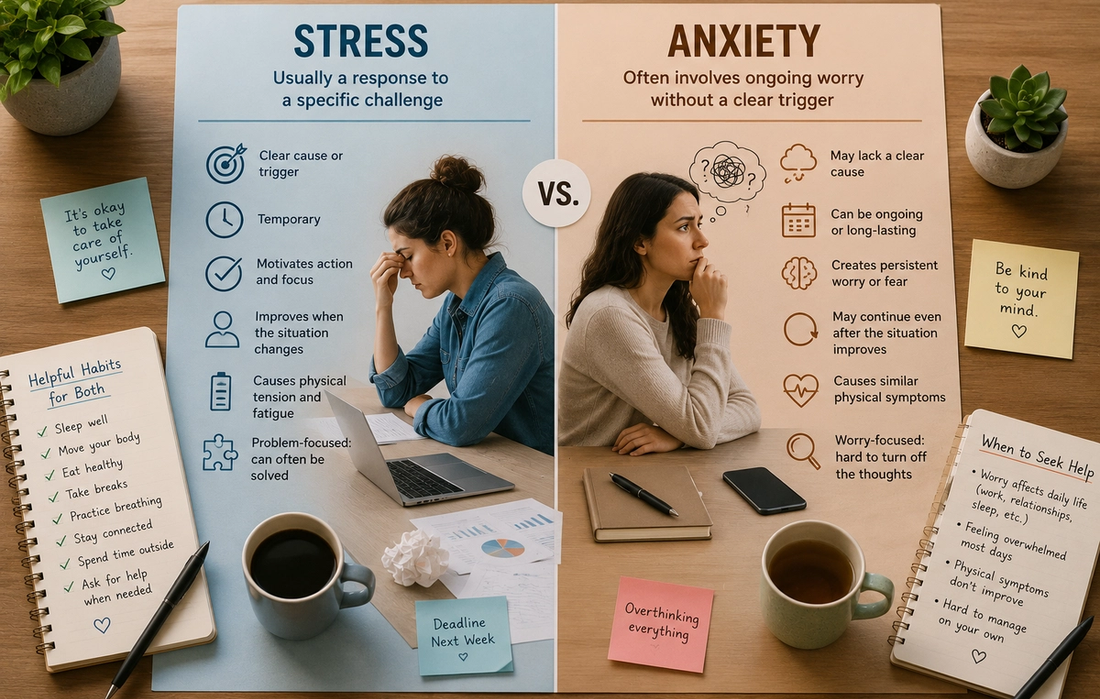
People often use the words stress and anxiety as though they mean the same thing.
Someone might say they’re anxious about an upcoming presentation when they actually mean they’re stressed. Others describe themselves as stressed even when they’re experiencing persistent worry that doesn’t seem connected to any specific situation. While the two experiences share many similarities—and can certainly occur at the same time—they aren’t exactly the same.
Understanding the difference can help you respond more effectively to what you’re feeling.
Neither stress nor anxiety is necessarily a sign that something is wrong. Both are natural responses that have helped humans survive for thousands of years. The challenge arises when these feelings become overwhelming, long-lasting, or begin interfering with everyday life.
What is stress?
Stress is your body’s response to a challenge or demand.
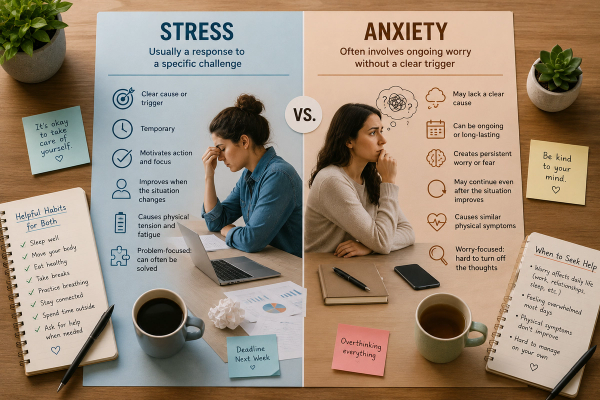
It usually has a clear cause. A looming deadline, an important exam, financial pressure, family responsibilities, moving house, or preparing for a major event can all trigger stress.
When you’re stressed, your body activates its “fight or flight” response. Your heart may beat faster, your muscles become tense, and your mind focuses intensely on solving the problem in front of you. In small amounts, stress can even be helpful because it encourages action and helps you stay alert.
The important thing is that stress is generally connected to something happening in your life.
Once the situation improves or disappears, stress often begins to decrease as well.
What is anxiety?
Anxiety is more than simply feeling stressed.
It often involves persistent worry, nervousness, or fear that continues even when there isn’t an immediate problem to solve. Sometimes anxiety begins in response to a stressful event, but it can also remain long after the original situation has passed.
People experiencing anxiety may find themselves constantly imagining worst-case scenarios, overthinking everyday situations, or feeling physically tense without being entirely sure why.
Unlike stress, anxiety doesn’t always need a clear trigger.
The mind may continue searching for possible dangers even when everything appears to be going well.
The symptoms can look very similar
One reason stress and anxiety are often confused is that they can feel remarkably alike.
Both may cause difficulty concentrating, muscle tension, headaches, trouble sleeping, irritability, fatigue, a racing heart, or an upset stomach. You might also feel restless, overwhelmed, or emotionally drained.
Because the physical symptoms overlap so much, the biggest difference is often what’s happening behind them.
Stress is usually connected to a specific challenge.
Anxiety often continues even after the challenge has ended—or appears without an obvious reason at all.
Stress usually fades when the situation changes
Imagine you’re preparing for an important job interview.
During the days leading up to it, you might feel tense, distracted, or find it difficult to relax. Once the interview is over, however, those feelings usually begin to ease, even if you’re still waiting for the result.
That’s a typical example of stress.
Your body responded to a specific situation and gradually returned to normal once the immediate pressure had passed.
Stress tends to come and go depending on what’s happening in your life.
Anxiety can become a cycle
Anxiety often behaves differently.
Instead of disappearing after one event, it can move from one concern to another. If one worry is resolved, another may quickly take its place.
Someone might spend weeks worrying about a presentation, then immediately begin worrying about their health, finances, relationships, or something that could happen in the future.
The mind becomes caught in a cycle of anticipating problems, even when there’s little evidence that those problems will occur.
This constant state of alertness can become exhausting over time.
Healthy habits help both
Although stress and anxiety aren’t identical, many healthy habits support both.
Regular physical activity, consistent sleep, balanced nutrition, limiting excessive caffeine, spending time outdoors, maintaining social connections, and making time for relaxation all help the body recover from periods of mental strain.
Simple practices such as deep breathing, mindfulness, journaling, or taking short breaks during busy days can also help reduce feelings of overwhelm.
These habits don’t eliminate every difficult emotion, but they make it easier to cope with life’s challenges.
When should you seek extra support?
Feeling stressed before an important event or anxious during uncertain times is completely normal.
However, if worry becomes persistent, begins affecting your work, relationships, sleep, or daily activities, or feels difficult to manage on your own, it’s worth speaking with a healthcare professional.
There is no shame in asking for support.
Mental health deserves the same attention as physical health, and early support often makes a significant difference.
Seeking help isn’t a sign of weakness.
It’s a practical step toward feeling better.
You don’t have to eliminate every difficult feeling
One of the biggest misconceptions is that good mental health means never feeling stressed or anxious.
That’s simply not realistic.
Life will always include uncertainty, challenges, and moments of pressure. Difficult emotions are part of being human. The goal isn’t to eliminate them completely but to understand them, respond to them in healthy ways, and recognize when additional support may be needed.
Understanding whether you’re experiencing stress or anxiety is one part of that process.
It allows you to respond with greater awareness rather than simply feeling overwhelmed.
Understanding the difference can make a difference
Stress and anxiety share many symptoms, but they often have different causes and patterns.
Stress usually develops in response to a specific challenge and tends to improve once that situation changes. Anxiety often involves ongoing worry that can continue even when no immediate threat is present.
Recognizing the difference doesn’t mean diagnosing yourself.
It simply helps you better understand what your mind and body may be trying to tell you.
In the end, both stress and anxiety are signals—not enemies. Paying attention to those signals, taking care of yourself, and seeking support when needed are all important parts of maintaining your overall wellbeing.






MORE IN TRENDING
How to Find Your Personal Style in 6 Steps
Sam Bitton .

How to Spot a Beauty Product That’s Actually Worth the Hype
Adi Liad .
The Privacy Settings Worth Changing on Every Device You Own
Roy Kaden Roi .

How to Spend Less Time on Your Phone Without Going Off-Grid
Roy Kaden Roi .

The Digital Habits of People Who Seem Calm Online
Jade Josef .